

Bird flu on the rise in Kathmandu, infection confirmed at 82 locations
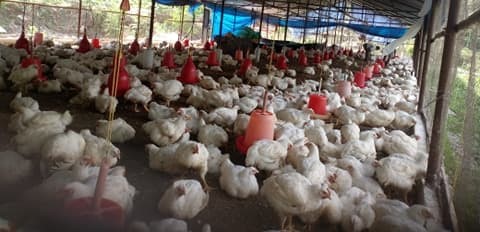
Kathmandu. The bird flu infection, which has been observed in the Kathmandu Valley for the last three months, has now started spreading rapidly.
According to the Department of Animal Services, the infection has been confirmed in 82 places in 11 districts so far, and special precautions have been taken in the affected areas to control the disease.
After bird flu was first confirmed in Morang on Chaitra 20, 2005, the infection spread to Jhapa, Sunsari, Mahottari, Bara, Chitwan, Nawalparasi, Kathmandu, Bhaktapur, Lalitpur and Kavrepalanchok.
According to Umesh Dahal, Director General of the Department of Animal Services, 569,858 birds have been destroyed so far in the course of infection control.
He informed that 989,313 eggs and 1,954.85 quintals of grains were also destroyed.
To control the disease, the Department of Animal Services has established a ‘Bird Flu Disease Control Cell’ under the leadership of the Deputy Director General and has mobilized technical teams to the affected areas in coordination with the federal, provincial and local levels.
According to the department, the infection has been brought under control in Jhapa, Morang and Sunsari in Koshi Province, as well as Bara, Mahottari, Chitwan and Nawalparasi. However, special surveillance has been increased as infections are still being seen in some areas of Kathmandu, Lalitpur, Bhaktapur and Kavrepalanchok, informed Director General Dahal.
The department has also announced that it has begun a gene sequencing process of the virus in collaboration with the National Public Health Laboratory to determine whether there have been any genetic changes (mutations) in the infected virus.
The department has urged poultry farmers to strictly follow biosecurity standards on farms, not to reuse old egg crates, to only allow transportation vehicles to enter the farm after completely disinfecting them, and to prevent domesticated birds from coming into contact with wild birds.
Similarly, the department has requested that it is mandatory to obtain a veterinary certificate when transporting poultry and poultry products, to get regular vaccinations, and to immediately inform the nearest animal services office if an unusually large number of birds are sick or dead on any farm.

Blood donation program organized by Lions Club of Mississauga Canada Nepal (with photo feature)

Bhotekoshi flood: Death toll reaches 788, 25 hundreed still unaccounted for

US-Canada trade war : Canadian Prime Minister Carney announces that the dollar will respond to the dollar

Growing attraction in domestic tourism: Why are Nepalis going out to travel?

FIFA World Cup 2026: Semi-final draw complete, Argentina-England, Spain-France enter the last four

Lions Club of Mississauga Canada Nepal’s Charter Night was a grand success (with photo feature)

FIFA Football: Which group matches will be played when? Canada vs South Africa exciting match today