NRNA’s 12th General Convention begins in Kathmandu
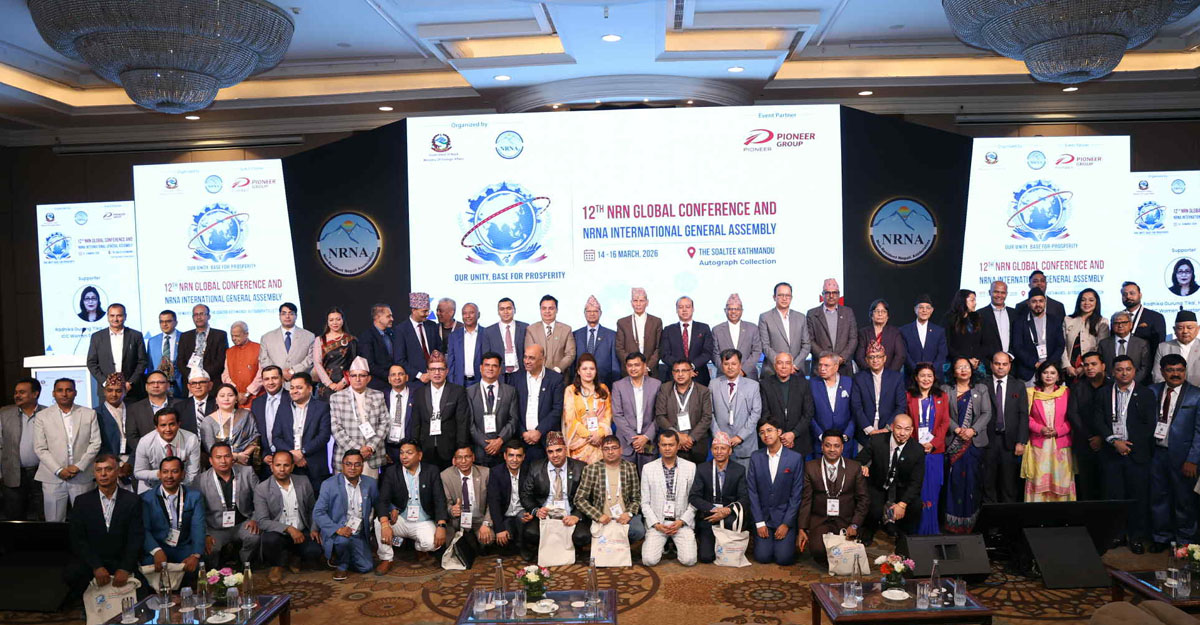
Kathmandu. The 12th Global Conference and International Conference of the Non-Resident Nepali Association (NRNA) has begun.
Foreign Minister Balananda Sharma and former Prime Minister Jhalanath Khanal inaugurated the convention by lighting a lamp at the Soaltee Hotel in Kathmandu.
Inaugurating the convention, Foreign Minister Sharma said that the experience, skills, and international contacts of NRNs are important for the development and transformation of Nepal. He said that this will contribute to industrial development and employment creation.
Stating that non-resident Nepalis are accepted as partners of the nation in Nepal’s constitution and laws, he said that investment and cultural responsibility should be increased.
He said that at a time when new challenges have emerged in the dimensions of international relations, the Non-Resident Nepali Association has a responsibility to increase the impact of investment and technology, and expand the scope of knowledge and capital.
Minister Sharma praised the Nepali cultural ambassador for his contribution to Nepali soil while living abroad.
He expressed his belief that NRNs will play an important role in bringing about Nepal’s economic development and prosperity.
Minister Sharma said that the government is aware of the security of Nepalis in distress in the Middle East. ‘The Nepalese government is aware of the concerns about the security of Nepalis due to the incidents seen in recent days. Concerns have increased about the security of Nepalis working in the Middle East. The necessary work is being carried out by keeping the security, welfare and assistance of Nepali citizens abroad as a high priority. An emergency control room has been brought into operation to address the problems seen in the Gulf. The ministry will act as a bridge between the workers and their families. Arrangements have been made to contact the Nepali mission and Nepal in case of any incident,’ he said.
Stating that collaboration between the government, private sector and non-resident Nepalis is essential for long-term investment, enthusiasm-oriented industries, innovation and a knowledge-based economy, he said that policy reforms and mutual trust are necessary for this. He said that for this, a coordination division has been established in the ministry and policy and operational reforms have been taken forward.
He said that inter-agency coordination is underway to improve the Non-Resident Nepali Act 064 and other necessary laws under Ncell . He expressed his commitment that the integrated data system of Nepalis living abroad will be further advanced in a more effective manner in the coming days.
Delivering a welcome speech at the inaugural ceremony, Executive Chairman Mahesh Kumar Shrestha said that there is a feeling in the hearts of Nepalis living abroad to do something for their homeland.
He said that unity has been established by ending disputes within the association and that non-resident Nepalis will continue to contribute to the campaign for a prosperous Nepal.
Stating that issues of citizenship, labor issues, and voting have been overshadowed by internal disputes, he said that the NRNA’s world conference and international convention will determine the future direction of the association and review the past.
He said that the upcoming working committee will play a role in sending a message that Nepalis around the world are united.
He said that the right to vote for everyone would be ensured through comprehensive reforms to the electoral system and delegate system, which have been a source of controversy within the union.
He emphasized that non-resident investment should be viewed differently from foreign investment and that the capital, skills, and knowledge of Nepalis living abroad should be utilized.
Founding President Upendra Mahato expressed happiness over the unity of the association.
He said that no matter how high one reaches in personal success, it will be meaningless if the country is not formed, and that the Non-Resident Nepali Campaign has been launched with the slogan ‘Nepalese for Nepal’.
He said that the Nepali people are capable in all aspects, but they just lack determination. He said that if they have the determination, they can become very prosperous. He stressed that the country should fight and make a determination to build Nepal when the rules and regulations are difficult. He said that there is a problem with visas and work visas, and he said that the country should be built first.
“Until we build our own country, we will be foreigners no matter which country we live in. So let’s start building our own country no matter which country we live in,” he said.
Stating that this is a campaign of 8 million non-resident Nepalis, he appealed to not offend other Nepalis if a 100-200 person gets into a disagreement. He urged the association to encourage the contribution made by 8 million Nepalis according to their capacity.
He said that unless investment from non-resident Nepalis comes, other foreign investments will not come either. He said that the internal industrial organizations have stopped coordinating with the NRNA and that the disagreement has not benefited anyone. He requested the association to work in a way that represents the 8 million overseas Nepalis.
“Let’s all move forward together and make the country prosperous,” he said.
Executive Chairman Dr. Badri KC said that he is at the forefront of the journey from division to unity and that unity will be further strengthened. He said that the former chairmen could not participate due to their busy schedules, but they have his support.
He expressed his commitment to ensure that not a single non-resident Nepali is deprived of their voting rights and to send those who are willing to work with responsibility.
Stating that non-resident Nepali citizenship was obtained from the Prime Minister, but it is not being implemented today, he said that the Non-Resident Act and other laws should be amended.
He requested the government to quickly remove the legal complications, saying that the old citizenship was also inactive and the new non-resident citizenship was not working. He demanded that the incoming government bring the Non-Resident Act to Parliament within 100 days and implement it. He said that the PNO Nepalis have preserved their language and culture, and demanded that they be given Nepali identity and non-resident certificates. He also urged that investment-related laws be amended to facilitate them and an environment be created for easy investment by non-resident Nepalis.
He said that even after receiving support from the NRN Development Fund, it could not be started due to the government’s lack of cooperation. He requested that an environment be created to inaugurate the upcoming conference. He complained that the government did not provide sufficient support, saying that non-resident Nepalis were expanding Nepal’s tourism and culture abroad at their own expense.
He demanded an increase in the staff at Nepali embassies abroad, saying that there was a problem in getting passports on time due to insufficient staff and that passports had to be issued through campaigns. Recalling that non-resident Nepalis had mobilized volunteers even during the Covid period, he said that the association was ready to cooperate with the government for the safety of Nepalis in the current deepening crisis in the Middle East.
Former President Binod Kunwar said that the unity convention has given completeness and the upcoming working committee will further complete the unity. He said that there is concern about the development of Nepal even though 8 million non-resident Nepalis are living abroad.
The first female president, Rabina Thapa, said that the organization’s goal is to reach consensus even if there are disagreements, and that it is necessary to reconnect with friends who have been separated.
He said that efforts should be made to make the country prosperous by bringing the knowledge, skills, capital, and expertise of Nepali expatriates to Nepal, and for this, unity among Nepali expatriates is necessary.
She said that the NRNA should coordinate with the new government to utilize the expertise of Nepali expatriates. She put forward the demand that the NRNA ministry be set up now, as every Nepali is migrating and the Ministry of Foreign Affairs looks after foreign affairs.
Former President RK Sharma said that it is necessary to advance the campaign for prosperity through collective investment of working Nepalis along with non-resident Nepali citizenship.
He said that some people were missing during the convention and that the new working committee should include them. He said that the government should pay attention to this, saying that the crisis in the Middle East is escalating.
Former President Jiva Lamichhane said that the NRNA campaign has been lagging behind due to division when many issues including citizenship and investment reached the decisive stage.
“I am happy today that all my friends have realized that no one benefits from division and that we need to come together. Only if we are united can we contribute and establish an agenda,” he said.
Former President Bhawan Bhatta said that the unity convention was a matter of joy. Stating that if a mechanism is created to bring investment from overseas Nepalis, investment from 90 countries can easily come in, he said that the focus should be on the hydro, agriculture, tourism and IT sectors. He expected the new government to pay attention to this.
Bhim Udas said that Nepal’s prosperity should be linked to the unity of the association and that the NRNA should play an important role in this.
He said that the incoming Nepal government, which has been promoting India and China with the help of the diaspora, should create an environment to invite them and make them partners in development.

Blood donation program organized by Lions Club of Mississauga Canada Nepal (with photo feature)
Bhotekoshi flood: Death toll reaches 788, 25 hundreed still unaccounted for
US-Canada trade war : Canadian Prime Minister Carney announces that the dollar will respond to the dollar
Growing attraction in domestic tourism: Why are Nepalis going out to travel?

FIFA World Cup 2026: Semi-final draw complete, Argentina-England, Spain-France enter the last four
Lions Club of Mississauga Canada Nepal’s Charter Night was a grand success (with photo feature)

FIFA Football: Which group matches will be played when? Canada vs South Africa exciting match today